Hairline Refinement
Some patients already have a reasonable amount of hair but want to strengthen or refine portions of the frontal hairline. A smaller graft requirement may make this type of restoration particularly well suited to Stealth FUE.
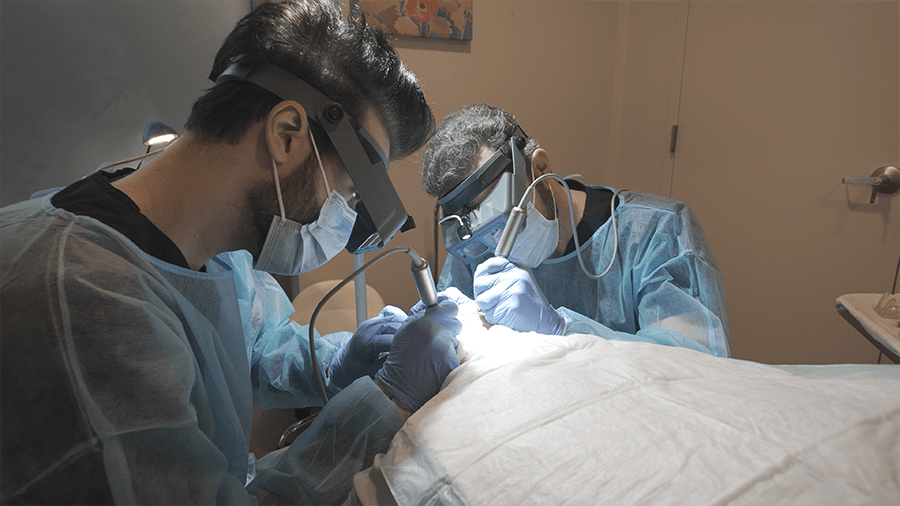
A More Discreet Approach to Hair Restoration
For some patients, one of the biggest concerns about having a hair transplant isn’t the procedure itself.
It’s what everyone else will see afterward.
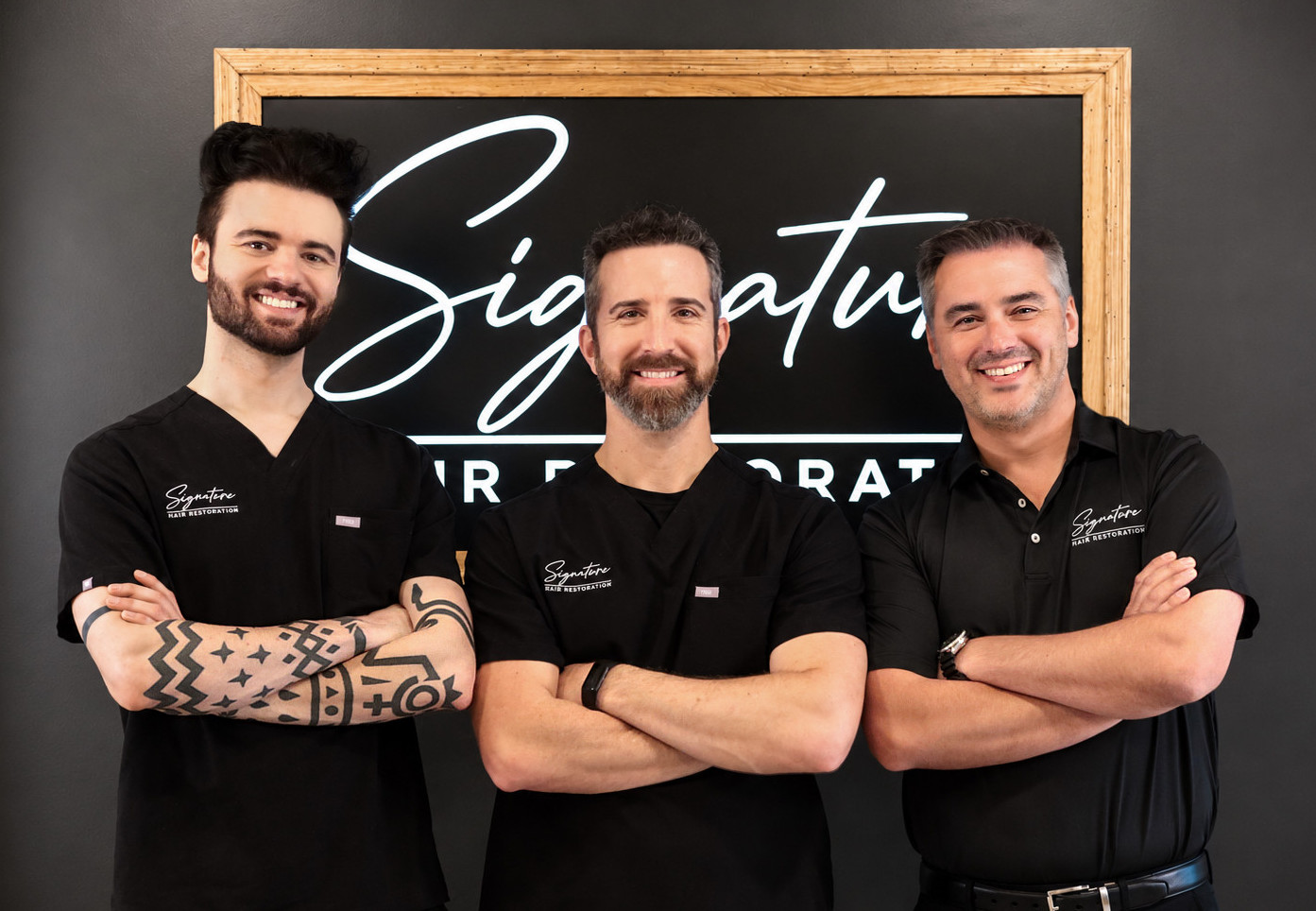
Traditional FUE often requires shortening or shaving a substantial portion of the donor area so individual follicular units can be efficiently extracted. For many patients, that isn’t a problem. For others—particularly professionals, women, patients with longer hairstyles, or anyone who simply wants to keep their procedure private—the visible donor shave can be a significant concern.
That’s why Signature Hair Restoration offers Stealth FUE for selected patients requiring approximately 1,000 grafts or less. With Stealth FUE, we strategically prepare smaller areas of the donor region while preserving longer surrounding hair whenever possible. That existing hair can then help camouflage the extraction area during the early recovery period.
The goal is simple: Restore your hair while making the procedure easier to keep private.
Stealth FUE uses the same fundamental Follicular Unit Excision technique as traditional FUE. Individual follicular units are harvested from the donor area—typically along the back and sides of the scalp—and transplanted into areas affected by permanent hair loss.
The primary difference is how the donor area is prepared. Instead of routinely shaving a large donor region, we strategically shorten limited sections of donor hair while preserving longer hair around them whenever the patient’s hairstyle and graft requirements allow. Those longer hairs can fall over the extraction areas and help conceal the signs of surgery.
Think of it as creating hidden donor zones within the existing hairstyle. The actual transplantation is still FUE. The difference is that the surgical plan places a greater emphasis on discretion.
This is one of the most important things for patients to understand. At Signature Hair Restoration, Stealth FUE is generally limited to approximately 1,000 grafts. That limit is intentional.
The discreet nature of the procedure depends on our ability to work within relatively small donor areas while preserving enough surrounding hair to camouflage those areas afterward. As graft requirements increase, we need access to progressively more of the donor region. Eventually, attempting to keep all of that donor preparation hidden becomes inefficient and may unnecessarily complicate the procedure.
For larger restorations, standard FUE usually makes more sense. For very large restorations requiring approximately 3,000 grafts or more, our Mega FUE protocol may be the better approach.
Stealth FUE is designed around discretion—not maximum graft numbers.
Stealth FUE may be particularly appropriate for patients requiring a
relatively focused restoration.
Some patients already have a reasonable amount of hair but want to strengthen or refine portions of the frontal hairline. A smaller graft requirement may make this type of restoration particularly well suited to Stealth FUE.
Isolated temporal recession may require fewer grafts than a full frontal restoration. For the right patient, Stealth FUE can restore these areas while minimizing visible donor preparation.
Female patients frequently have longer hairstyles and may be particularly concerned about shaving a visible portion of the donor area. For women who are otherwise good transplant candidates and require a smaller number of grafts, Stealth FUE can be an attractive option.
Selected patients with naturally high hairlines or relatively small areas requiring reshaping may also fall within the Stealth FUE graft range.
Some scars from previous surgery or trauma may require a relatively limited number of follicles. These smaller procedures may also be appropriate for a discreet donor approach.
Stealth FUE isn’t the best approach for every patient. The most obvious limitation is procedure size. If we estimate that you need significantly more than approximately 1,000 grafts, we will usually recommend standard FUE rather than trying to force a larger procedure into a Stealth FUE format.
The primary objective is still a technically sound hair transplant.
We won’t compromise donor access, graft quality or the overall surgical plan simply to avoid trimming hair.
Other factors may also make Stealth FUE less practical, including:
Both procedures use Follicular Unit Excision to harvest individual follicular units.
The primary difference is donor preparation.
Stealth FUE prioritizes discretion.
We limit donor preparation whenever possible and preserve surrounding hair to help cover extraction areas.
At Signature, Stealth FUE is generally reserved for procedures of approximately 1,000 grafts or less.
Standard FUE prioritizes efficient access to the donor area.
Larger portions of the donor region may be shortened so follicles can be harvested evenly throughout the appropriate donor zone.
This generally makes more sense when the graft requirement extends beyond the range where a concealed donor approach remains practical.
Neither procedure is inherently better.
They solve different problems.
These procedures are almost opposite ends of the spectrum.
Generally up to approximately 1,000 grafts
Primary goal: Discretion
Typically appropriate for smaller, targeted restorations.
Primary goal: Efficient restoration
Appropriate for many routine procedures requiring more donor access.
Generally considered at approximately 3,000+ grafts
Primary goal: Large-scale coverage and donor planning
At Signature, these procedures are typically divided across two consecutive surgical days and may address multiple cosmetic units.
The right procedure depends on what you’re trying to accomplish—not which name sounds the most appealing.
Not necessarily. Hair-transplant terminology can be confusing.
are sometimes used interchangeably even though they can describe meaningfully different techniques.
Recent medical literature has specifically identified inconsistency in the terminology used to describe shaven, partially shaven, unshaven and long-hair FUE procedures.
Researchers have proposed more standardized definitions so patients can better understand exactly what is being performed.
At Signature, Stealth FUE is our practice-specific name for a discreet FUE strategy.
Our goal is to preserve cosmetically useful surrounding hair while giving our surgical team adequate access to harvest the planned grafts. That is different from promising that absolutely no donor hair will be shortened.
True long-hair FUE is a specialized variation of follicular unit excision in which follicles can be harvested while maintaining the longer hair shaft. Published medical literature describes long-hair FUE as a way to avoid traditional donor shaving and reduce some of the visible signs of surgery.
That doesn’t mean every discreet FUE procedure needs to be performed using true long-hair extraction. True long-hair FUE can also be more technically demanding and slower than conventional shaved FUE.
Harvested long hairs still shed after placement in the recipient area. Patients must wait for new growth and results.
Signature’s Stealth FUE is designed to find a practical balance:
Preserve enough surrounding hair to improve concealment while maintaining efficient access to the follicles we need to harvest.
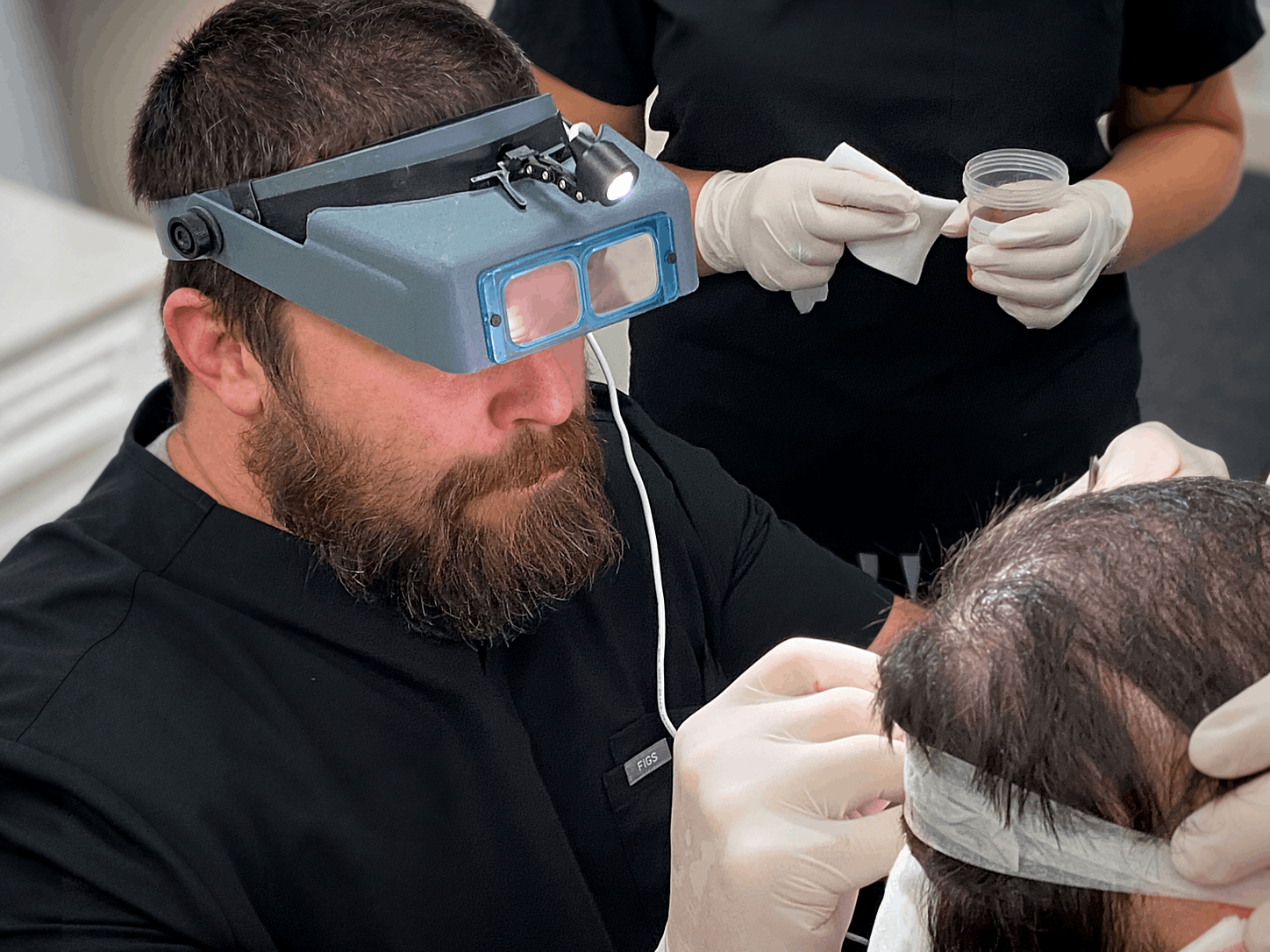
Stealth FUE works in part because the patient’s existing hair provides camouflage. If longer hair remains above or around a strategically prepared donor section, that hair may fall over the area and conceal much of the early redness and extraction pattern.
We recommend donor hair at scissor-cut length, at least two finger widths long. That means Stealth FUE often works best for patients who already maintain enough hair length to cover the donor region.
A patient with a longer hairstyle may be an excellent candidate. A patient who wears a very short fade or buzz cut may gain substantially less benefit because there simply isn’t enough surrounding hair available for concealment.
FUE creates numerous small extraction sites where individual follicular units have been removed.
With Stealth FUE, much of this area may be hidden beneath the longer surrounding hair. That is one of the principal cosmetic advantages of preserving the patient’s existing hairstyle.
Published literature on long-hair and unshaven FUE likewise describes donor-area shaving as a significant concern for patients who want their surgery to remain discreet.
However: Stealth does not mean invisible.
A person closely examining the scalp immediately after surgery may still recognize signs of a procedure. Our objective is to make the recovery easier to conceal during normal everyday interactions, not to promise that surgery is completely undetectable.
The recipient area is separate from the donor area.
In many smaller procedures, we may be able to transplant between existing hairs while preserving much of the patient’s hairstyle.
The recipient area can still display redness and small crusts during early healing.
Keeping the donor area hidden does not eliminate the normal healing process in the area receiving the grafts.
One of the main reasons patients choose Stealth FUE is the desire for a more discreet return to normal life.
Preserving surrounding donor hair can make the back and sides of the scalp less conspicuous after surgery.
However, the time it takes for the overall procedure to become socially inconspicuous varies between patients.
If you have an important meeting, wedding, presentation or other event, tell us before scheduling the procedure.
We can help you develop realistic expectations about timing.
Stealth FUE may be particularly valuable for women undergoing smaller
hair-restoration procedures.
Many female patients are understandably reluctant to shave a noticeable area of the back or sides of their hair.
With the appropriate hairstyle and donor characteristics, strategically prepared donor areas may be covered by the patient’s longer surrounding hair.
However, being able to conceal the donor area does not automatically make someone a good surgical candidate.
Female patients still require careful evaluation of the cause of hair loss and the stability of the donor region.
Stealth FUE changes how we access the donor hair.
It does not change the fundamentals of hair-transplant candidacy.
Stealth FUE may be a smaller procedure, but donor management is still important. Hair transplantation relies on a finite supply of donor follicles. Published hair-transplant guidelines emphasize evaluating donor density, follicular miniaturization, hair caliber and the boundaries of the safe donor area before FUE harvesting.
Extraction also needs to be distributed appropriately. Excessive harvesting can create visible thinning, patchiness and scarring within the donor region. A discreet donor shave isn’t useful if the donor area itself is poorly managed. Our priority remains preserving the long-term appearance of the donor region.

FUE should not be described as truly “scarless.”
Every surgical extraction site undergoes a healing process.
Unlike strip harvesting, FUE does not create one long linear donor scar. Instead, it creates numerous small individual extraction sites distributed throughout the donor region.
In appropriately selected patients, these sites typically become difficult to notice once healed and covered with surrounding hair.
Hair-transplant literature recognizes pinpoint scarring and visible donor depletion as potential complications of FUE, particularly when harvesting is excessive.
For that reason, we prefer language such as “no linear scar” rather than “scarless.”
Stealth FUE and traditional FUE both relocate follicular units from the donor area to the recipient area.
The primary advantage of Stealth FUE is cosmetic discretion during early recovery. It isn’t intended to produce biologically superior follicles.
Published literature evaluating long-hair FUE has reported comparable final outcomes while also noting that the technique can be slower than shaved FUE. The quality of a transplant ultimately depends on much more than whether the donor area was shaved.
Some patients are completely comfortable shaving their donor area. Others want their hair transplant to remain as private as possible. Neither preference is right or wrong.
For patients requiring approximately 1,000 grafts or less, Stealth FUE may provide an excellent balance between hair restoration and discretion. For larger procedures, standard FUE usually provides better surgical access. And for patients requiring approximately 3,000 grafts or more, our two-day Mega FUE protocol may offer a more appropriate approach.
At Signature Hair Restoration, we aren’t trying to fit every patient into the same procedure. We’re trying to determine which procedure makes the most sense for your hair loss, donor supply, graft requirements and lifestyle.
If maintaining your existing hairstyle and minimizing the visible signs of donor harvesting are important to you, ask us whether you’re a candidate for Stealth FUE. Schedule a consultation with Signature Hair Restoration to find out whether Stealth FUE is right for your restoration.
Medical information on this page is intended for educational purposes and does not replace an individualized medical or surgical evaluation. Procedure selection, donor preparation, graft numbers and candidacy vary by patient.


